
Sedgwick Falcons
"We think of Falcons as what school is supposed to be - trusted adults, new perspectives, group learning, accountability, a reliable opportunity to see friends, community building, a mix of personalities, a sphere outside of the family to take pride in, collaborative problem-solving, social skills, etc. - without the features of typical schools that don't work for us." -Falcons Parent
Serving students roughly ages 5-16, the Sedgwick class meets from 9-1:00 on Wednesdays and Fridays at Anna’s home in Sedgwick, Maine. There students study a wide variety of topics while also learning through the tasks needed to grow and maintain their community, whether it be stitching notebook bindings, using Town Meeting methods to make decisions, or building their own meteorological tools to produce a weekly weather report for the student newspaper.

What does a typical Sedgwick falcons day look like?
First piloted by the original Falcons group in 2016, and honed and adapted as needed since then, the current Sedgwick Falcons day usually unfolds as follows:
Morning Jobs:
Students arrive each day to a collection of tiles, slates, and other writable objects each inscribed with a job necessary for either the daily maintenance of our classroom (making the calendar page for a new month and filling in important dates) or a new endeavor (measuring out the ingredients to be ready for a science lab later.) This system ensures that students develop their skills in context, learning how to apply them in their very real lives simultaneously to building the skill itself. It also creates an empowered sense of ownership over the classroom and all that occurs in it, and maintains the understanding that education benefits the learner immediately, rather than at some future time. By seeing their contributions to their classroom bear fruit, students understand the purpose of their skills, and reap immediate rewards from gaining them.
These jobs often also involve making or using our own tools, such as stitching journals, constructing a ten-meter timeline and regularly adding dates connected to our studies, or building a wind gauge, compass, or protractor. When students make their own tools, the lessons they learned by constructing them get reactivated with each use, assisting in memory and a much deeper understanding of the concepts that they would otherwise gain.
Reading/Letter/Question of the Day:
While this offering varies greatly depending on student level, each manifestation of it ensures a daily encounter with written language in a manner calculated to build positive associations with it. For the youngest students, this often consists of making their first set of letter tiles by practicing their handwriting on small clay disks, which are then fired and become their spelling set. Slightly older readers might then use these tiles, often mixed with others containing common letter combinations like “ee” or “ing” to build a Story of the Day for those at that level to read and copy/illustrate for handwriting practice. The most advanced students receive a question related to our study topics, such as “How can a group make decisions in a way that ensures that everyone gets what they need?” and from this practice essay-writing skills.
Problem of the Day:
As with the above, Problem of the Day takes different forms depending on student level. The oldest students calculate the angles and measurements needed to laser cut a new dollhouse (complete with fiel trip to cut it out!) or graph any of a number of data samples that we can collect from our classroom or the world around us. Some even make their own “theorem kits’ for use in geometrical proofs.
The youngest students, on the other hand, learn addition, multiplication, subtraction, and division through a series of toys and characters: math gnomes, place value dolls, bead rods, and fraction disks, many of which they make or maintain themselves.
One of our best creations is the “Pizza Shop,” a corner of the classroom given over to a play kitchen infused with math. The pizzas (felted by the class) teach fractions, and wrapping paper sushi sold by the piece works perfectly for multiplication. At its most in-depth, students use currency for their transactions, earn money by working shifts as servers, pay sales and income tax (at rates set by the class Town Meeting system), and can put their money in the class bank (a beautiful cardboard creation) to earn interest (calculated by student bank managers.) Math, civics, art, and play all run together in the world of the Falcons classroom - just as they do in real life.
Task Time:
Though choice weaves itself throught the Falcons day (students choose which jobs and levels of each of the previous activities they wish to do) a wider scope of choice time awaits them when those are done. “Tasks” - interactive activities that exercise a particular skill or explore a specific concept - line every wall of our room, and students are free to choose from them as soon as the first parts of the day are done. Examples include exploring science specimens, using an orrery (student-made) to align the months of the year with the equinoxes, map-making, recreating the rock cycle with wax, shading a drawing of an egg, making a doll, weaving, printing, or any other skill a student demonstrates that they would benefit from exercising. Students also often design tasks for themselves or one another, undertake in-depth projects, or dovetail Task Time with tutoring assignments if they are enrolled in tutoring as well. The variety of tasks, and the choice-based format allow each student to start where they are and build specific skills from there rather than keeping pace with anyone else, while still receiving the benefits of learning in community.
Verse and Gathering:
Each day we hold a class meeting, which we transition into by saying a verse, usually connected to what we are studying, and, as often as possible, from a poet or text that students will likely come across in future. This has included the opening lines of the Odyssey, work by Langston Hughes and Robert Frost, and even sacred texts related to the practices of community members who want to share them with the group.
When students hear the verse, they practice putting everything away, and then lay out our Gathering Cards: a set of “comminity tools” and advice written (by the students) on cards set in a spiral to guide how our Gathering discussions go. Students then roll the stone Talking Egg to one another to take turns speaking. As in the Online Class, they also use different hand signals to practice deepening their conversation skills, such as “build on,” “question,” “disagree,” and “reframe.”
Many different things occur in Gathering - stories, Town Meetings, science demonstrations, the occasional guest speaker, and discussions on every sort of topic. Our classroom and community provide the training ground for many of our civics topics, and we also respond to the wider world around us by studying weather, geology, holidays, sugaring, how ideas spread, intercultural local history, or any other topic that it benefits students to explore together.
Lunch/Shares/Suggestions/Complement Circle:
A lot of great things can happen when people sit down to eat! In our class lunch time also serves as Show and Tell - and whatever conversations emerge from that - and a chance to reflect on the day and decide what folks would like to learn more about. These become the day’s Suggestions - optional homework that gets emailed out to families along with the daily update, and can include books and other learning resources that students recommend to one another, practice of skills or concepts they want to do more with, or observation assitgnments such as “notice five invertebrates before next class.” As in the Online Class, we also finish our day with Complement Circle, a student-created tradition in which they share compliments, thank yous, and wishes for one another, reflecting one another’s best selves back to them and noticing the roles each person plays in the community.
Recess:
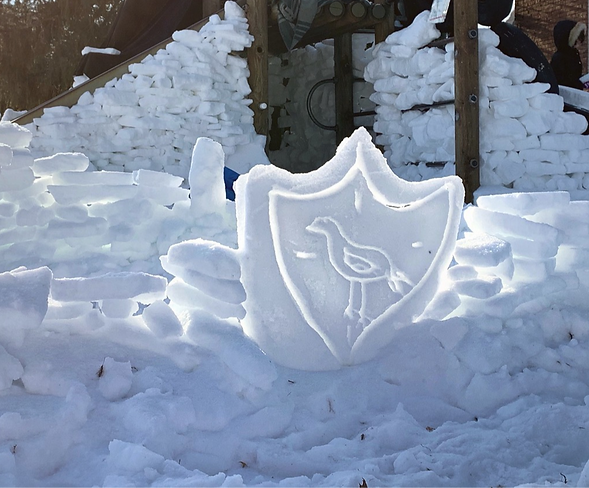
We finish off our day outside, which takes any shape the students want it to! Games like Fire in the Forest can dovetail (or launch) class topics like animal classification, kids can make houses under the trees or chase a soccer ball, organize as a group or play separately. The days that go down in legend are snow fort building days when the most fantastic creations appear in the yard!
The comparatively early Falcons end time means that there is still plenty of day left for other adventures, and families often organize playdates or library trips to correspond with Falcons days so that the community momentum of the class can continue out into the world as well.
How do that many ages learn together?
Quite well, actually! The format of our classroom means that, while students are always in community, they are very seldom all doing the same thing at the same time, making it easy to differentiate for both age and level. In fact, the variety of ages plays a powerful role in dignifying the variety of levels: every aspect of our class expects that different learners are in different places, so there is no sense of being “behind” or “ahead” and no stigma associated with what one knows or how one learns.
Students often collaborate on daily jobs and projects, each bringing their existing skills to the task, and learning from one another as they go. Because Falcons assignments strive never to be arbitrary, the presence of many learning levels also lends relevance to many activities, such as an older student writing a story book for a younger one, or a younger one practicing fractions by splitting index cards into 8ths because the older students need them to make something - often a tool or student-led project that the younger student will then, in turn, partake in.
Logistics
Schedule:
Sedgwick Falcons meets on Wednesday and Fridays from 9am-1pm. We follow a September-June school year with a traditional winter and February break. Spring break usually coincides with Passover and/or Easter.
Cost:
The cost for Sedgwick Falcons is $2,950 for the year, split into ten payments of $295 each, due on the first of every month, September-June. Sibling discounts are available.
What do we do the rest of the week?
Families looking for educational support on Mondays, Tuesday, and Thursday are encouraged to explore our tutoring and homeschool support options, or the Falcons Online Class (really: take a look! It has to be seen to be understood:-)).
Online student-led clubs can also be a great way to add some spice and socializing to a week. All of our offerings are coordinated with one another, making them an easy way to build a multifaceted, personalized homeschool experience.
Please see our Other Offerings page for occasional further opportunities, as well.
